

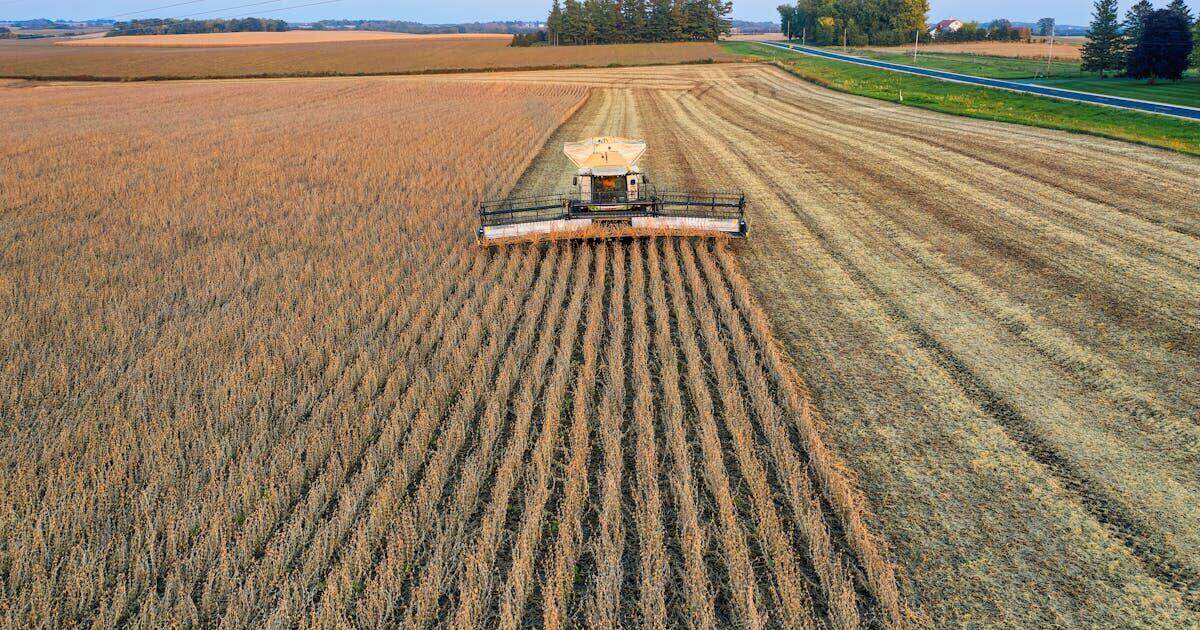
In April 2026, Bloomberg ran a headline that cut through the noise: "Bankers Descend on Untapped $270 Billion Market Far From Brazil's Wall Street." Money managers are leaving São Paulo's Faria Lima financial district — Brazil's answer to Wall Street — to chase farmers' riches deep in the country's agricultural heartland.
This is not journalistic hyperbole. Agribusiness accounts for roughly 25% of Brazil's GDP, and the country is the world's largest exporter of soybeans, coffee, sugar, orange juice, chicken, and beef. Yet financial access to this productive chain has historically been concentrated in rural credit lines from state banks and largely inaccessible to private investors. That is changing — and the instruments available to individual investors have never been broader.
Why the timing matters
Three simultaneous forces are converging to push Brazilian agribusiness to the center of global attention.
China-Brazil trade hit a record. In 2025, bilateral trade between the two countries reached US$ 171 billion, driven largely by China's reallocation of soybean purchases away from the United States. As US tariffs made American soybeans more expensive for Chinese buyers, procurement shifted toward Brazil at an accelerated pace. The direct result was stronger demand for Brazilian commodities and a persistent inflow of export dollars, with the real trading around R$ 4.99 per dollar, reflecting robust agricultural export revenues.
The Selic rate cut changes the fixed-income equation. With Brazil's benchmark interest rate on a downward trajectory, instruments such as CRAs (Certificados de Recebíveis do Agronegócio, or Agribusiness Receivables Certificates) and Fiagro fund shares become more competitive against CDI-linked deposits. When the Selic was at 15%, conventional fixed income was hard to beat. With the rate converging toward 12.25% by year-end — according to the Focus survey compiled by Brazil's Central Bank — private credit instruments with income-tax exemptions become proportionally more attractive.
Institutional capital is entering the sector. Global asset managers are structuring dedicated funds to finance Brazil's agricultural supply chain, from grain producers in Mato Grosso to protein processors in Pará. This institutional flow tends to develop the secondary market and expand liquidity in instruments available to retail investors.
Info
Brazil is the world's largest exporter of soybeans, coffee, sugar, orange juice, chicken, and beef. Agribusiness accounts for roughly 25% of national GDP and generated US$ 171 billion in bilateral trade with China in 2025 alone.
The available instruments: what each one is
Before evaluating opportunity or risk, it is worth understanding what actually exists in the market for investors seeking exposure to Brazilian agribusiness.
CRAs: Agribusiness Receivables Certificates
A CRA is a fixed-income security issued by securitization companies, backed by receivables originating from agribusiness operations — rural financing, input purchases, land leases, and export contracts, among others.
The most important feature for individual investors is the income-tax exemption on earnings. This exemption, established under Law 11.033/2004, makes the net yield on a CRA systematically higher than a comparable taxable instrument such as a bank certificate of deposit (CDB). At Brazil's standard 15% IR rate on financial investments, the after-tax advantage is material.
CRAs can be fixed-rate, floating-rate (indexed to CDI or IPCA inflation), or hybrid. Maturities typically range from two to ten years, which implies lower liquidity compared to government bonds. The primary risk is credit risk on the issuer or the underlying receivables portfolio: defaults by rural borrowers can impair the security's payments.
Fiagros: Agribusiness Investment Chain Funds
Fiagros were created in 2021 under Law 14.130 and are frequently described as "the FII of agribusiness" — a useful but incomplete analogy. Just as Real Estate Investment Funds (FIIs) distribute rental income, Fiagros distribute income from their portfolios, which can include CRAs, LCAs (rural credit notes), bank deposits from rural banks, shares in agribusiness companies, and stakes in agricultural properties.
There are three subtypes: Fiagro-CRA (focused on agricultural credit), Fiagro-FIA (focused on agribusiness stocks), and Fiagro-FIP (stakes in unlisted companies). For retail investors, Fiagro-CRA funds are the most accessible, with shares traded on B3 and monthly distributions that are income-tax exempt for individual investors.
The Selic rate cut benefits Fiagros in two ways: it increases the market value of the credit securities held in the portfolio, and it makes the yields distributed by the fund more competitive in relative terms. Market data indicates that several Fiagros were generating annualized dividend yields above 12% in early 2026, though these figures vary with portfolio composition and the price at which shares are purchased.
Agribusiness stocks on B3
The third access route is direct equity: shares in listed companies with exposure to the sector. Some of the most relevant names include:
Suzano (SUZB3): the world's largest producer of eucalyptus pulp. A 2026 BTG Pactual survey identified Suzano as the top agribusiness stock pick in a scenario of President Lula's re-election, citing stable Asian demand, a favorable exchange rate for exporters, and a highly competitive cost structure.
SLC Agrícola (SLCE3): one of Brazil's largest grain producers, with direct exposure to soybean, cotton, and corn price cycles.
BrasilAgro (AGRO3): a company focused on acquiring, developing, and leasing agricultural land. It functions as a proxy for rural land appreciation.
JBS (JBSS3) and Marfrig (MRFG3): large protein processors with strong export exposure to China and the Middle East.
Agribusiness equities have their own dynamics: results depend on commodity cycles, exchange rates, weather events, and global trade policy. They carry more volatility and risk than CRAs or Fiagros but offer higher capital appreciation potential.
Warning
No instrument is free of risk. CRAs carry credit risk and low secondary-market liquidity. Fiagros may trade at a discount to net asset value. Agribusiness stocks are sensitive to commodity cycles, exchange rates, and weather conditions. Past performance does not guarantee future results.
The B3 agricultural derivatives market
Beyond the instruments above, B3 has a growing agricultural derivatives market with futures contracts on soybeans, coffee, corn, live cattle, and ethanol. These instruments enable hedging by producers and exporters, as well as directional trading by market participants.
Trading volumes in agricultural commodity futures on B3 have grown consistently, tracking Brazil's deeper integration into global supply chains. For retail investors without a hedging structure, agricultural futures require technical knowledge and adequate capital for margin management. They are better suited for experienced operators.
Risks that deserve attention
The enthusiasm around agribusiness is grounded in fundamentals, but it does not eliminate structural and cyclical risks.
Climate risk: El Niño and La Niña events affect harvests unpredictably. A severe drought in Mato Grosso or a frost in Paraná can reduce soybean and coffee production in a single crop season, directly impacting companies and funds with sector exposure.
Trade policy risk: The US-China tariff war that currently benefits Brazil could resolve or escalate in unexpected ways. A commercial rapprochement between the world's two largest economies could abruptly reduce Chinese demand for Brazilian soybeans.
CRA liquidity risk: The secondary market for CRAs remains underdeveloped. In stress conditions, selling a CRA before maturity can imply a significant discount to face value.
Political and regulatory risk: Changes in environmental policy, rules governing foreign land leases, or export policy can affect the sector in a systemic way.
Why institutional capital is heading to the interior
Bloomberg's reporting describes money managers leaving air-conditioned offices in São Paulo to visit farms in Mato Grosso, Goiás, and Bahia. This is not corporate tourism: it is the materialization of an investment thesis that Brazil's financial market spent decades building the infrastructure to support.
Brazilian agribusiness operates at industrial scale with relatively low costs, growing infrastructure (railways, bulk-commodity ports), and access to cutting-edge precision farming technology. But it historically depended on subsidized rural credit from BNDES and state banks. The development of capital markets instruments — CRAs and Fiagros — is now allowing private capital, including international capital, to finance this chain directly.
B3 registered strong growth in listed Fiagros between 2022 and 2026, moving from an embryonic market to an asset class with billions in assets under management. That institutionalization is precisely what attracts international managers: mature markets have sophisticated instruments, liquidity, and transparency.
Tip
For investors looking to understand the sector, following the earnings reports of companies such as Suzano, SLC Agrícola, and BrasilAgro is a practical way to grasp the revenue dynamics, cost structure, and exchange-rate exposure of Brazilian agribusiness.
Thinking about allocation
There is no universal answer to how much of a portfolio should go into agribusiness. It depends on time horizon, risk tolerance, and individual goals. But some general considerations apply.
For investors seeking income with income-tax exemption, CRAs from high-quality (investment-grade) issuers or established Fiagros can complement a traditional fixed-income portfolio, particularly in a declining Selic environment.
For investors who accept volatility in exchange for capital appreciation potential, shares in export-oriented agribusiness companies benefit from a weaker real and strong global demand for protein and grains.
For investors who want broad sector exposure without selecting individual securities, some Fiagro-FIA funds offer a diversified basket of agribusiness stocks in a single vehicle.
In all cases, diversification and understanding of the specific instrument are essential. Brazilian agribusiness has solid fundamentals, but the instruments that represent it have very different risk-return profiles.
How Royal Binary operates in this environment
At Royal Binary, our active management approach tracks major macroeconomic flows — including commodity appreciation and the realignment of global trade. Environments like the current one, with a favorable exchange rate for exporters, elevated Chinese demand, and a declining Selic making private credit more competitive, create conditions for identifying opportunities in agribusiness-related assets.
Our team executes more than 340 trades per month using a methodology developed over more than 6 years of professional market experience by Sidnei Oliveira. Sector analysis is an integral part of the opportunity identification process.
Past results do not guarantee future returns. All returns are variable income.
Tip
Want to understand how Royal Binary's active management model identifies opportunities in environments like today's agribusiness boom? Explore our plans and trading history at app.royalbinary.io.