

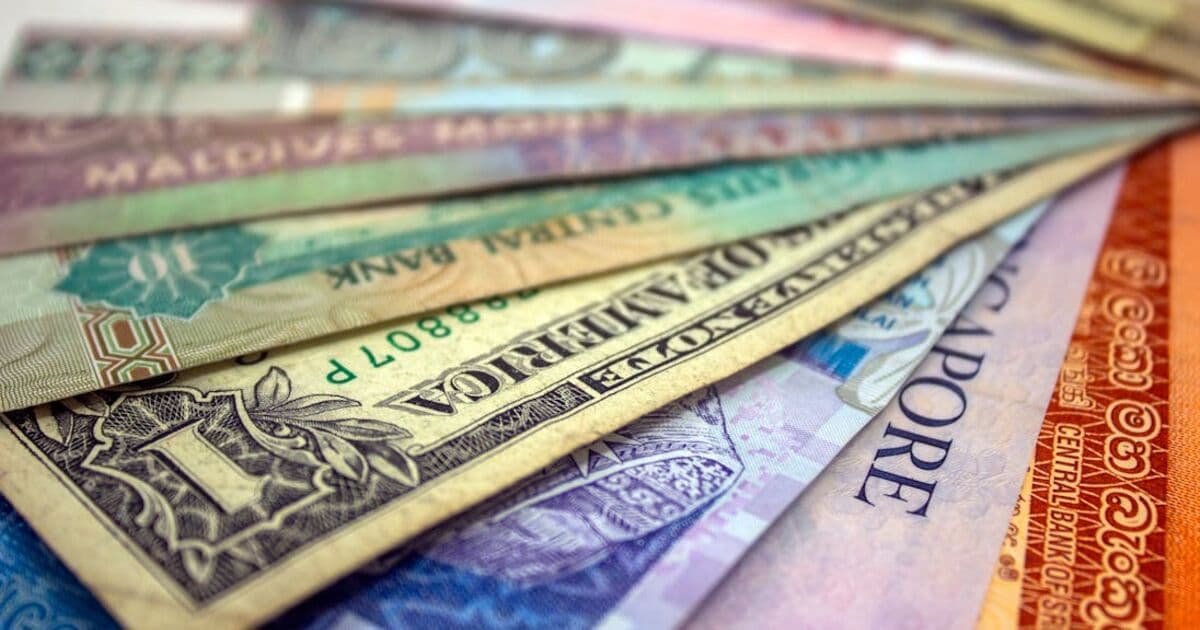
When most people talk about diversification, they think about splitting a portfolio between equities, fixed income, real estate funds, and maybe some crypto. It's a reasonable starting point. The problem is that in 2026 that structure has started ignoring a variable that's dominating global returns: the currency in which the asset is denominated.
The USD lost ground consistently in the first quarter. The BRL appreciated enough to attract R$53 billion in net foreign inflows in just the first few months of the year. Gold reached $4,722, a record that reflects less the fear of an American recession and more an ongoing multi-currency dilution process. The Japanese yen is fragile: every time the BoJ signals a new tightening move, a portion of the trillions of dollars in JPY-funded carry trades needs to be unwound in a hurry.
In this environment, holding stocks and bonds all denominated in BRL is not real diversification. It's a concentrated bet on a single currency trajectory.
Why 2026 Is Different
The currency moves this year are not short-term noise. They reflect three structural forces diverging at distinct speeds and in distinct directions.
The first is the interest rate differential. The Selic stands at 14.75%. The Fed maintains its rate in the 3.5%–3.75% range. That creates a differential of roughly 11 percentage points — one of the widest between economies with functional financial markets. Institutional capital capable of executing carry trades sees this and acts. The R$53 billion inflow into Brazil is not coincidental; it's the mechanics of interest rate arbitrage operating at scale.
The second force is the BoJ's adjustment path. The futures market prices in two more 25-basis-point rate hikes during 2026, bringing the Japanese policy rate to roughly 1.1%. For those who operated for years borrowing cheaply in yen to finance positions in higher-yielding assets worldwide, each BoJ step forces a partial unwind of those positions. In August 2024 we saw a preview of what happens when that unwind occurs in a disorderly fashion — globally synchronized volatility, within hours. The difference now is that there's a signaled rate-hike path from the Japanese central bank, not merely a one-off surprise.
The third force is Mexico's distinct cycle. Banxico cut its rate to 6.75% on March 26, 2026, and the peso is trading at MXN$17.93 per dollar. An economy that cuts rates while its primary trading partner — the United States — still operates in restrictive mode creates a specific currency dynamic: outflows, pressure on the peso, and consequences for anyone with exposure to Mexican assets without hedging.
What "Currency Exposure" Means in Practice
When you buy IVVB11 — the ETF replicating the S&P 500 listed on B3 — you are buying American stocks with partial or no currency hedge, depending on the fund's structure. If the USD depreciates against the BRL, the real-denominated return of the fund declines, regardless of how the American stocks performed in dollar terms.
The inverse is also true. An American investor who allocated to Ibovespa at the beginning of 2026 captured two simultaneous returns: the rise of Brazilian stocks in reais, plus the BRL appreciation against the USD. For that investor, the dollar return was amplified by the currency. For a Brazilian who stayed only in BOVA11, the equation was simpler: just the BRL return.
That's the central point. Cross-currency exposure is neither exotic nor speculative. It's the natural consequence of holding assets in different currencies. The question is whether you manage that exposure deliberately or simply let it happen without noticing.
Hedged vs. Unhedged: When Each Makes Sense
The decision to hedge currency risk or not depends on the objective, the time horizon, and the cost of protection.
For long-term positions — ten years or more — there's a reasonable argument that currency fluctuations tend to net out over time, and that the cost of hedging (especially at high interest differentials like the current one) erodes returns. If the Selic is at 14.75% and American rates are at 3.5%, the cost of hedging USD by selling dollars forward is significant. A currency-hedged U.S. equity fund needs to overcome that structural disadvantage before delivering any alpha.
For tactical or medium-term positions, hedging makes more sense — especially when you have a specific thesis on the currency direction or when expected currency volatility is high enough to dominate the return of the underlying asset.
Gold at $4,722 illustrates a case where the hedge-vs.-unhedged debate becomes more complex. Part of the gold thesis in 2026 is precisely the dilution of multiple fiat currencies — the metal rises because the USD, EUR, and other currencies lose purchasing power in a non-synchronized fashion. Hedging the USD in a gold position would eliminate part of the exposure that justifies holding the asset in the first place.
Implementation: How to Build Multi-Currency Exposure
There are practical ways to add currency diversification to a portfolio without necessarily leaving the Brazilian market or opening international accounts.
The most direct route is through B3-listed ETFs that replicate global indexes without currency hedging. IVVB11 gives USD exposure. Equivalent funds exist for EUR and JPY with reasonable liquidity. The key is understanding that you're not just buying American or European stocks — you're also buying (or selling) the currency.
Global multi-asset investment funds with a mandate to actively manage currency exposure can be useful for those who prefer to delegate that decision. The disadvantage is the management fee and the opacity about how the manager is positioned in currency at any given moment.
Structured operation certificates (COEs) referencing international assets sometimes offer capital protection in reais — which is, in practice, an embedded currency hedge. The cost of that protection is always implicit in the structure, and it's worth calculating.
For investors with access to international accounts, the construction is more direct: allocate to American, European, or emerging-market ETFs and explicitly decide whether or not to hedge with forward currency contracts.
The Mistake Most Investors Make
Most investors think about diversification as "not concentrating in a single company" or "holding equities and fixed income." Those rules are valid but operate one level below the real problem in 2026.
The real risk today is not the failure of a specific company. It's the possibility that your domestic currency depreciates against the currency of the asset you'll need to buy in the future — whether that's American technology, European energy, Japanese goods, or simply dollars for travel or foreign expenses.
The BRL strengthened significantly in 2026. That's good for those who already held unhedged international positions — the real return was amplified. But strengthening is not permanent. The real is historically one of the most volatile emerging-market currencies. The R$53 billion in foreign capital inflows that drove the appreciation can reverse at the same speed it arrived, if the interest differential narrows, global risk appetite shifts, or the commodity cycle turns.
Building multi-currency exposure when the BRL is strong — as it is now — is precisely the right moment to do it. Diversifying currency when the real has already depreciated 20% carries a different cost and a different opportunity set.
An Integrated Reading of the Scenario
The four moves I opened this piece with — weak USD, strong BRL, gold rising, fragile yen — are not isolated events. They are manifestations of the same phenomenon: a world in which the major central banks are operating radically different monetary policies simultaneously.
The Fed in moderately restrictive mode. The BoJ exiting a decade of zero rates, with the market pricing hikes to ~1.1%. Banxico cutting to 6.75% while trying to balance domestic inflation and exposure to the American cycle. Copom at 14.75%, with no near-term cut prospect given the Focus-revised inflation projections running consistently higher.
In environments like this, currency ceases to be noise around an asset's return and becomes the primary determinant of return. Ignoring that is taking on risk of unknown size. Managing it consciously transforms a risk factor into a dimension of potential alpha.
At Royal Binary, we work with currency flow analysis, global interest rate differentials, and positioning across multiple geographies. If you want to understand how this type of exposure can be built within your portfolio's context, access our platform.