

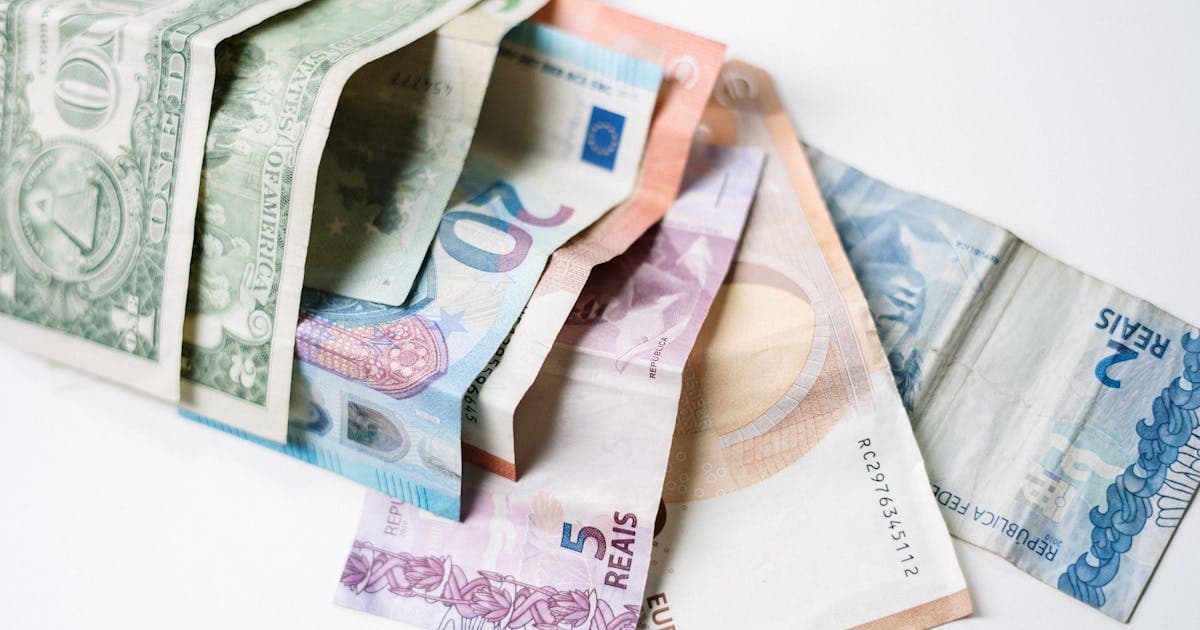
On Monday, April 13, 2026, the US dollar closed at R$4.997 against the Brazilian real — the lowest closing level since March 2024, when the exchange rate last touched R$4.98. During the session, the intraday low reached R$4.96. On the same day, the Ibovespa set a new all-time record, closing above 198,000 points for the first time.
For context: in September 2025, the dollar was trading near R$5.80. In less than seven months, the US currency has shed nearly 9% against the real.
This is not a coincidence or a random fluctuation. It reflects a convergence of structural and cyclical forces that are worth understanding before making any portfolio decisions.
What is driving the dollar lower
The interest rate differential: the most durable force
Brazil's central bank benchmark rate, the Selic, currently stands at 14.75% per year. The US Federal Reserve is operating with rates in the 4.25%–4.50% range. That spread of roughly 10 percentage points makes Brazilian fixed-income assets unusually attractive to international capital seeking yield.
When foreign investors buy Brazilian government bonds to capture that differential, they sell dollars and buy reais. Greater demand for the real means downward pressure on the dollar. This mechanism, known as carry trade, accounts for a significant portion of the capital inflows Brazil has been receiving.
According to Brazil's central bank, the country recorded a net inflow of US$29.3 billion in portfolio investments over the 12 months through February 2026.
Foreign capital flows at record levels
B3 exchange flow data reinforces this picture. Through April 10, the month had already registered a net inflow of R$14 billion. The year-to-date positive balance exceeded R$65 billion — excluding equity offerings such as IPOs and follow-ons.
This volume of foreign capital does not enter the country by accident. It responds to a combination of elevated interest rates, a positive trade balance, and sustained commodity prices.
Geopolitical relief as the short-term trigger
The immediate catalyst on April 13 was a statement from President Donald Trump indicating that Iran had expressed interest in diplomatic negotiations. Global markets interpreted this as a reduction in geopolitical risk, benefiting risk assets in emerging market economies, including the Brazilian real.
This factor is episodic and volatile, unlike the interest rate differential, which is structural. But it served as the trigger that pushed the exchange rate through the psychologically significant R$5 threshold.
| Indicator | Value |
|---|---|
| Dollar closing rate on 04/13/2026 | R$4.997 |
| Intraday low on 04/13/2026 | R$4.96 |
| Last close below R$5 | March 2024 |
| Weekly decline | 2.9% |
| Year-to-date decline | 8.72% |
| Net portfolio inflows (12 months) | US$29.3 billion |
| YTD exchange flow balance at B3 | R$65 billion+ |
| Ibovespa on the same day | 198,000 pts (record high) |
What a weaker dollar means in practice
The exchange rate is not an abstract number. It affects importers, exporters, investors, and consumers in very different ways. Here is what the current move means across different profiles.
For importers and consumers
Imported goods become cheaper. Electronics, vehicles, industrial raw materials, and pharmaceutical inputs all carry lower costs when the dollar weakens. In the near term, this reduces inflationary pressure in import-dependent categories.
For end consumers, the effect takes time to reach store shelves, but it is real. Sectors with significant import content should see some pricing relief over the next few quarters.
For investors with dollar-denominated assets
Investors who already hold dollar-linked positions — currency funds, BDRs, US equity ETFs, or dollar-denominated fixed income — see those positions decline in real terms. A BDR worth R$1,000 when the dollar was at R$5.40 is worth less today with the dollar at R$4.99.
On the other hand, investors who have not yet built international diversification find a more favorable entry point. The cost of initiating a position in dollar-denominated assets is lower. This does not necessarily mean it is the "right moment to buy" — but the entry conditions have changed.
For Brazilian exporters
This is where the impact is most negative. Companies that earn in dollars and incur costs in reais — soybean producers, iron ore miners, pulp exporters, protein companies — receive fewer reais per dollar of revenue.
Vale and Petrobras, two of the largest companies on the Ibovespa, are directly influenced by the exchange rate. When the dollar falls, their real-denominated revenue contracts. Their shares tend to face pressure depending on the magnitude and duration of real appreciation.
Will the real continue to strengthen?
That is the question everyone asks, and no one answers honestly in categorical terms.
What can be analyzed are the factors that support or threaten the current move.
Supportive factors:
- Elevated Selic (14.75%) keeps the interest rate differential attractive
- Positive trade balance continues to bring dollars in via exports
- Focus survey projections indicate the Selic ending 2026 near 12.5%, still well above the Fed
- Commodities including soybeans and iron ore remain elevated
Risk factors:
- Brazilian election year: fiscal uncertainty tends to rise as the campaign season advances in the second half of 2026
- The Federal Reserve may hold rates higher for longer than expected, compressing the differential
- Any escalation in global geopolitical tensions tends to strengthen the dollar as a safe-haven asset
- Real appreciation may gradually reduce the carry trade premium over time
The short-term environment is favorable, but there is no basis for assuming R$4.99 is a permanent floor.
What to do with this information
There is no single answer. It depends on each investor's profile, objectives, and current portfolio composition. But there are practical questions worth addressing:
Do you have currency exposure in your portfolio? If so, evaluate whether the current proportion still makes sense. With the real stronger, currency hedging carries a higher opportunity cost relative to local assets.
Do you lack international diversification? The exchange rate near R$5 offers a historically more favorable entry point compared to the R$6 levels seen in late 2024. Diversification is not a directional bet on the currency — it is a reduction in concentration risk.
Do you hold shares in Brazilian exporters? Monitor them more closely. Companies like Vale, Petrobras, JBS, and Suzano have margins directly affected by the exchange rate. A sustained drop in the dollar can pressure earnings in the coming quarters.
Are you positioned in Brazilian fixed income? This is the position that benefits most from the current environment: high yields in reais, with the currency having already appreciated significantly.
Info
A dollar below R$5 is not automatically good or bad. It is a market condition that calls for position review depending on where each investor is exposed. A well-diversified portfolio captures opportunities in both directions.
A note on the Ibovespa
It is not coincidental that the Ibovespa record and the dollar decline happened on the same day. Foreign capital entering Brazil buys reais and, in large part, flows into equities. Greater demand for Brazilian shares pushes prices higher.
The Ibovespa closed at 198,233 points on April 13, marking its 18th all-time record of the year. Blue chips Vale and Petrobras led the session, supported by foreign inflows and commodity strength abroad.
This context is relevant for equity investors. The Ibovespa's 2026 rally has been driven partly by foreign capital, not only by domestic fundamentals. That makes the market more sensitive to flow reversals if the global environment shifts.
How we operate in this environment
At Royal Binary, we use active management and a methodology that does not depend on directional bets on the exchange rate. With over 340 trades per month and more than 6 years of experience built by Sidnei Oliveira in financial markets, our model seeks to identify opportunities across different market conditions.
A dollar below R$5 is relevant context. But it does not change our process: technical analysis, disciplined risk management, and alignment of interests with the investor through the 50/50 profit-sharing model.
Past results do not guarantee future returns. Returns are variable income.
Tip
Want to understand how Royal Binary operates across different currency and interest rate scenarios? Learn about our plans and trading history at app.royalbinary.io.