

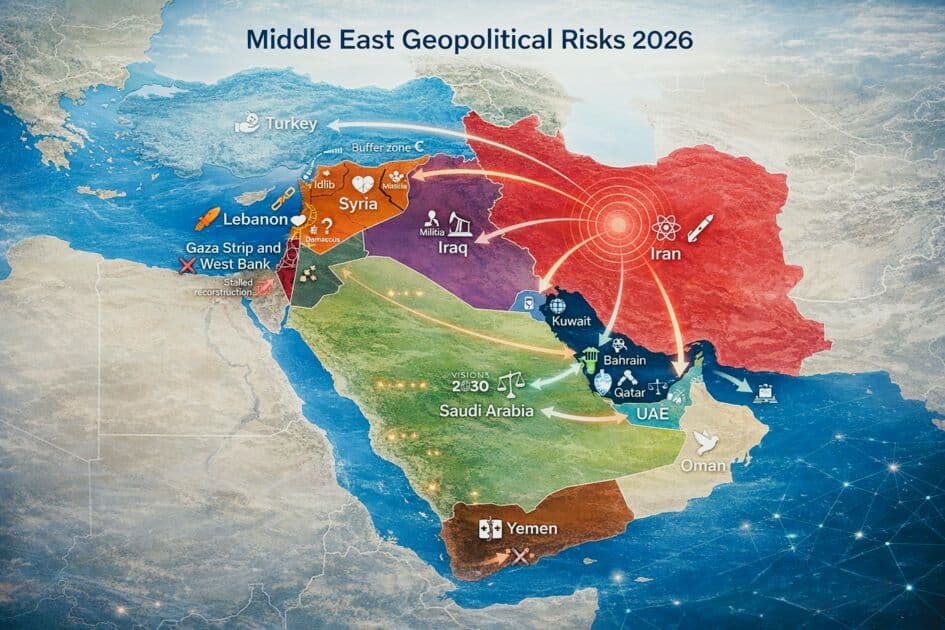
On February 28, 2026, the United States and Israel launched coordinated airstrikes against Iran, killing Supreme Leader Ali Khamenei and hitting over 900 targets in 12 hours. Five weeks later, the conflict continues with no end date in sight. The Strait of Hormuz, through which 20% of the world's oil supply passes, remains effectively closed. Brent crude went from $71 per barrel on February 27 to $112 on April 3, a 58% surge in just over a month.
Financial markets are now pricing two parallel scenarios: one where a ceasefire materializes in the coming weeks and another where the conflict escalates into a prolonged regional war. The two paths lead to very different destinations for investors.
Conflict timeline
To understand where we are, we need to see how we got here.
| Date | Event |
|---|---|
| Feb 28 | US and Israel launch coordinated strikes on Iran; Khamenei killed |
| Mar 1 | Iran confirms Khamenei's death; retaliates with missiles against Israel and US bases |
| Mar 2 | IRGC closes the Strait of Hormuz to commercial traffic |
| Mar 8 | Brent surpasses $100 for the first time since 2022 |
| Mar 11 | UN Security Council passes resolution demanding end to attacks |
| Mar 18 | Brazil's central bank (Copom) cuts Selic rate from 15% to 14.75% |
| Mar 23 | Trump suspends strikes on Iranian energy infrastructure for 5 days |
| Mar 24 | US sends 15-point peace plan to Iran via Pakistan |
| Mar 25 | Iran rejects the plan and presents 5 conditions to end the war |
| Mar 27 | Brent hits $114 after IRGC reaffirms Hormuz closure |
| Mar 31 | Netanyahu says military objectives achieved "beyond the halfway point" |
| Apr 1 | Trump claims Iran asked for ceasefire; Tehran denies it |
| Apr 2 | 12 vessels transit Hormuz (vs. 138/day pre-war); Ibovespa at 188,052 |
| Apr 3 | Iran allows Philippine-flagged vessels; Brent at $112.42 |
The two proposals on the table
The American plan: 15 points
On March 24, the US sent Iran a 15-point proposal through Pakistan. The full details have not been publicly released, but official sources indicate it includes: a one-month ceasefire, dismantling Iran's nuclear program, reopening of the Strait of Hormuz, limits on Iran's ballistic missile program, and sanctions relief in return.
The White House confirmed that "there are elements of truth" in press reports but cautioned that not all coverage was "entirely factual."
Iran's counterproposal: 5 conditions
Iran rejected the American plan and presented five conditions of its own:
- Complete end to aggression by the US and Israel against Iran and allied forces in Lebanon and Iraq
- Concrete mechanisms to guarantee the war will not resume
- Payment of war reparations for damages caused
- End of conflict on all fronts, including allied groups across the region
- Iranian sovereignty over the Strait of Hormuz
Point 5 is the most explosive. Washington demands the strait be reopened; Tehran demands recognition of its sovereignty over it. A direct impasse.
Scenario A: ceasefire in the coming weeks
The odds of a deal by April 30 fell from 50% to 30% in the past week, according to market analysts. But if it happens, the impact would be immediate.
Oil
Goldman Sachs estimates the geopolitical risk premium on Brent is between $14 and $18 per barrel. With a ceasefire and gradual reopening of Hormuz, Brent could fall to the $80-85 range by Q3, according to the EIA (U.S. Energy Information Administration).
Equities
Brazil's Ibovespa closed Q1 at 187,952 points, up 16.35%, its best quarterly performance since 2010. A resolution would remove the primary source of uncertainty weighing on global markets. Cyclical sectors, retail, and construction would likely lead the recovery.
The S&P 500 has shown a clear pattern since the conflict began: gains on Monday through Wednesday, then selloffs on Thursday and Friday. A ceasefire would break this cycle.
Interest rates and inflation
Brazil's Focus survey revised the 2026 IPCA inflation forecast from 3.8% to 4.1% due to the conflict. With a ceasefire and falling oil, inflationary pressure eases and Brazil's central bank gains room to accelerate rate cuts. The market currently expects a 0.25 p.p. cut at the April 28-29 Copom meeting, but a peace scenario could reopen the door for 0.50 p.p., bringing the Selic rate closer to the 12% year-end projection.
Currency
On April 1, the Brazilian real strengthened to R$ 5.15 per dollar, returning to pre-war levels, driven by signals of a possible deal. Year-to-date, the real has appreciated 6%.
Petrobras and the energy sector
BTG Pactual added Petrobras (PETR4) to its recommended portfolio for April, replacing Prio (PRIO3). The thesis: even with Brent falling to $80, Petrobras would deliver approximately 8% dividend yield and 9% free cash flow yield in 2026. In a peace scenario, investors trade commodity appreciation for dividend predictability.
Petrobras is already up 56% in 2026, and BTG still sees upside.
Scenario B: escalation and prolonged war
If negotiations fail and the conflict intensifies, the effects would be very different.
Oil
Goldman Sachs warns that if Hormuz disruptions continue and worsen, Brent could surpass its all-time high of $147 (reached in 2008). The current crisis is already described as the largest energy supply disruption since the 1973 crisis.
Before the war, 138 vessels transited the strait daily. By April 2, that number was 12. Iran granted selective access to vessels from China, Russia, India, Iraq, and Pakistan, but broad commercial transit remains blocked.
Equities
An Exame analysis identified a pattern over the past five weeks: the Ibovespa rises early in the week (optimism about negotiations) and falls on Fridays (frustration with lack of progress). The S&P 500 accumulated 9% in losses counting only Thursday and Friday sessions since the conflict began.
Sustained escalation would particularly pressure companies exposed to imported commodities and interest-rate-sensitive sectors, as the central bank would be forced to slow the cutting cycle.
Interest rates and inflation
With oil above $120, imported inflation would force the central bank to revise its rate path. The Focus survey's year-end Selic projection has already risen from 12% to 12.13%. In a prolonged war scenario, analysts consider it possible that the Selic ends the year at 13% or higher, with the central bank halting rate cuts entirely.
Gold: the counter-intuitive surprise
In previous wars, gold served as a safe haven. Not this time. Gold hit an all-time high of $5,602 per ounce in late January, before the conflict, and has since fallen 25%, trading around $4,500 in April.
The explanation: the oil shock raised US inflation expectations, increasing the probability of Federal Reserve tightening. This strengthened the dollar and pushed up real US interest rates, two factors that historically pressure gold downward.
J.P. Morgan projects $6,300 per ounce by year-end 2026. Deutsche Bank projects $6,000. But in the short term, the war has worked against the metal.
Side-by-side comparison: two possible worlds
| Indicator | Scenario A: Ceasefire | Scenario B: Escalation |
|---|---|---|
| Brent (Q3 2026) | $80-85 | $130-147+ |
| Ibovespa | Uptrend, cyclicals lead | High volatility, defensives and commodities |
| Selic (Dec 2026) | 12-12.25% | 13%+ |
| IPCA 2026 | ~4.1% | 5%+ |
| USD/BRL | R$ 5.00-5.15 | R$ 5.40-5.60 |
| Petrobras (PETR4) | Attractive dividends (~8% yield) | Appreciation via oil price |
| Gold | Gradual recovery | Short-term pressure, long-term upside |
What to watch in the coming weeks
April 6: strike pause deadline
Trump suspended strikes on Iranian energy infrastructure until April 6. What happens after that date is the first concrete test. An extension signals progress; resumed strikes signal failure.
April 28-29: Copom meeting
Brazil's central bank decides on the Selic rate with the conflict as backdrop. The magnitude of the cut (0.25 vs 0.50 p.p.) will serve as a barometer of how the central bank assesses the inflationary risk from oil.
Hormuz: vessels as an indicator
The number of vessels transiting the strait is a real-time indicator. From 138/day pre-war to 12 on April 2. Each increase signals de-escalation; each decrease signals risk.
Mediation bloc: Pakistan, Turkey, Saudi Arabia, Egypt
Indirect negotiations through Islamabad have stalled. Turkey and Egypt are exploring new venues such as Doha or Istanbul. Any announcement of resumed talks tends to move markets.
What this means in practice
There is no "right" position when the main variable is geopolitical. Wars do not follow pricing models. But some principles remain valid:
Diversification is not optional. Anyone who concentrated their portfolio in a single sector or asset class is exposed to moves no analyst can predict. Splitting across fixed income, equities, and international assets reduces the impact of any individual scenario.
Volatility is not the enemy of professional traders. Brent moving 4% in a single day, the Ibovespa swinging between optimism and pessimism on alternating days: this is the kind of environment where professional trading management operates. Discipline, risk management, and strategy matter more in moments like this than in sideways markets.
Data over opinions. The price of oil, the number of vessels in Hormuz, central bank projections, and rate decisions are observable and measurable. Opinions about "when the war will end" are not.
At Royal Binary, founded by Sidnei Oliveira, our professional trading team monitors these indicators daily. The volatility generated by geopolitical conflicts is part of the environment we operate in, with the discipline and risk management that six years of market experience demand.
Want to understand how professional trading operates in high-volatility scenarios? Explore the platform and learn about our plans.