

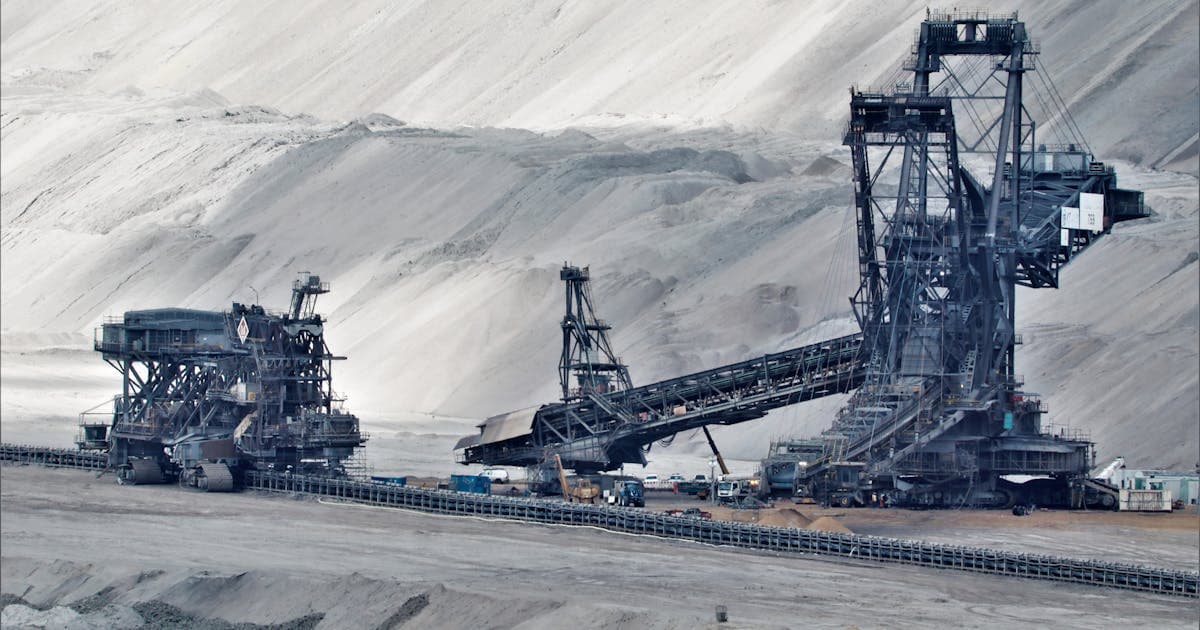
Iron ore is one of the most politically charged commodities in the world. It finances governments, determines the performance of giants like Vale, BHP and Rio Tinto, and serves as an indirect thermometer for the health of the Chinese economy — the planet's largest steel consumer. In 2026, the debate about iron ore fundamentals has returned to center stage.
Vale reports its first-quarter 2026 results on April 23. The iron ore spot price was trading above $100 per tonne in mid-April — while prices implied by Vale and BHP share prices suggest the market prices in something between $86 and $87, indicating expectations of a medium-term pullback. The IMF projects 4.4% growth for China in 2026. And Brazil-China trade hit a record $171 billion in 2025.
These numbers coexist with a bearish narrative: Westpac warned in December 2025 of a potential 20% drop in iron ore prices through 2026, as China scales back steel output. Two plausible scenarios, real data. What should investors consider?
The fundamentals of Chinese demand
China consumes roughly 65% of global iron ore production — a concentration unmatched by any other commodity. What happens in Chinese construction, infrastructure, and heavy industry determines global iron ore prices.
In 2026, the Chinese economy faces meaningful structural tensions:
- The real estate sector, which historically accounted for 25-30% of Chinese steel demand, is still adjusting following the collapse of Evergrande and other developers
- The Chinese government has been stimulating infrastructure — railways, wind and solar energy, urban construction — as a substitute for real estate demand
- China launched a 2025 program to consolidate iron ore purchasing through CMRG (China Mineral Resources Group), seeking greater bargaining power with miners
The IMF's projected 4.4% GDP growth for China is positive in absolute terms, but represents a deceleration from historical trajectory. And the composition of growth matters: green infrastructure uses less steel per yuan invested than traditional construction.
Supply dynamics: Brazil and Australia competing
On the supply side, global iron ore production is expanding:
| Producer | 2026 Projection |
|---|---|
| Vale (Brazil) | Up 5.9% to 462.9 Mt |
| BHP (Australia) | Stable, under price pressure |
| Rio Tinto (Australia) | In negotiations with CMRG |
| Others (Africa, Canada) | Gradual expansion |
Vale delivered $38.4 billion in net sales revenue and $15.5 billion in adjusted EBITDA in 2025, with recurring free cash flow of $4.8 billion. For 2026, the planned 5.9% production increase signals the company's confidence in medium-term fundamentals.
Brazilian iron ore exports in Q1 2026 reached 84.8 million tonnes — up 0.8% in volume and 2.4% in value, reaching $6.2 billion. Total mining sector revenue grew 21.5% in the period to $11.4 billion, according to IBRAM.
The super cycle: the debate that won't end
The commodity super cycle concept — a prolonged period of above-average prices driven by structural demand shifts — has been debated since China began its accelerated urbanization in the 2000s.
The clearest super cycle of the 21st century took iron ore from around $15/t in 2000 to nearly $180/t in 2011. The subsequent correction was brutal: by 2015, iron ore reached $38/t.
Arguments for a new super cycle:
- Energy transition requires enormous quantities of steel for wind turbines, transmission lines, charging infrastructure
- Emerging countries (India, Southeast Asia, Africa) are at early urbanization stages that China has already passed
- Growing environmental regulations limit opening of new mines
Arguments against:
- China is in a maturity phase, not acceleration
- CMRG consolidating demand could pressure prices lower
- Alternative materials (aluminum, carbon fiber) are advancing in specific applications
- Westpac projects a fall to $83/t by end of 2026
The market consensus, expressed in implied prices from mining company shares, is more aligned with the medium-term bearish scenario than with a new super cycle.
Brazil-China trade and strategic implications
Bilateral Brazil-China trade reached $171 billion in 2025 — a historical record. Brazil primarily exports commodities (ore, oil, soybeans) and imports manufactures. This structure has consequences:
Brazil is highly dependent on Chinese growth for its positive trade balance. If China slows beyond projections, Brazilian exports suffer in both volume and price — a combination that affects the exchange rate, federal revenue (via mining royalties and export taxes) and the performance of mining stocks on B3.
Export destination diversification is a recurring discussion in Brasília, but structural dependence on China takes years to change.
Vale on B3: what to monitor
Vale shares (VALE3) function as a proxy for the market's view on iron ore. On April 14, 2026, VALE3 rose 1.13% in a positive market environment. The Q1 results, due April 23, will answer specific questions:
- Production and sales volumes in the quarter
- C1 cost per tonne of iron ore produced
- Debt levels and cash generation
- Dividend projections for 2026
The market will use these data to update its view on whether Vale's current valuation — which trades at a meaningful discount to historical multiple averages — is appropriate or represents an opportunity.
Three points for investors
1. Spot price vs. implied price. Iron ore above $100 in the spot market coexists with implied prices of $86-87 in mining company shares. This means the equity market has already discounted a fall. If the spot price drops to the implied level, shares do not necessarily decline — because that scenario is already priced in.
2. Dividends as a cushion. Vale has a history of substantial dividends when cash flow allows. With Brazil's Selic rate high, dollar-denominated mining company dividends carry specific attractiveness for investors seeking currency exposure with income.
3. China is the central risk. Any deterioration beyond expectations in the Chinese economy — a trade conflict with the U.S. escalating, the real estate crisis deepening, growth below 4% — pushes iron ore prices down quickly. This is the risk that investors in VALE3 or mining ETFs need to monitor closely.
Volatility that markets track
Metals commodities create significant swings in short periods. Royal Binary, founded by Sidnei Oliveira, operates in this type of volatility with risk management structure and macroeconomic context analysis. Results vary, as with any variable-income operation.
Explore the platform and see how it works.