

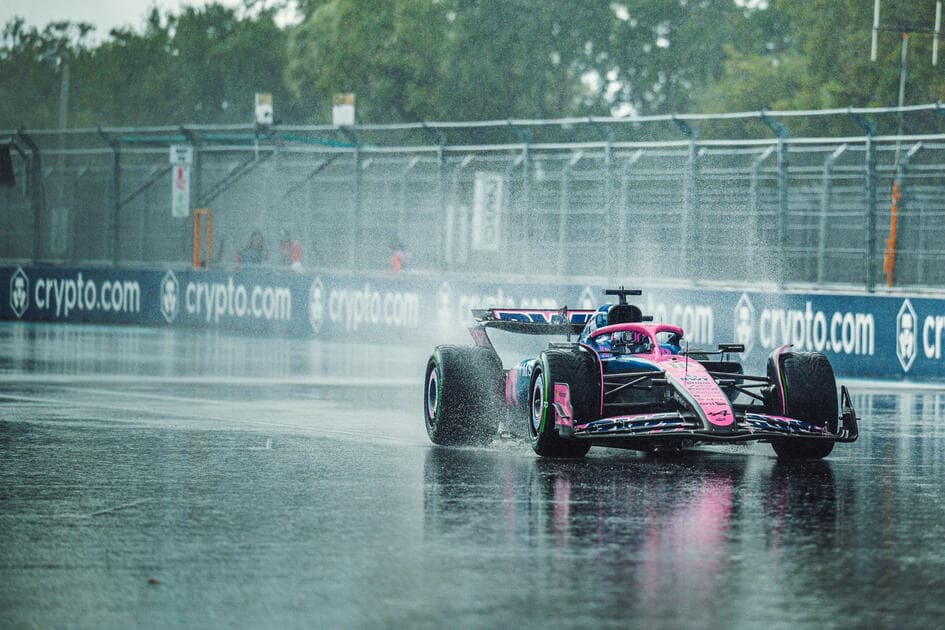
On the second weekend of May 2025, Miami came to a standstill. More than 270,000 people passed through the gates of the Miami International Autodrome. Hotels in the area reached 98% occupancy weeks before the event. Restaurants operated above capacity for four consecutive days. And at the end of that weekend, the bill was presented: $505 million in direct economic impact generated by a single motorsport race.
The Miami Grand Prix is not just a sporting event. It is a value-generation mechanism that cuts across at least four sectors of the economy simultaneously: entertainment, media, tourism, and luxury goods. For anyone who invests or follows the markets, understanding this chain is more useful than simply watching the race.
The economy behind a race weekend
The $505 million impact in a single weekend places the Miami GP in a category that few sporting events in the world can reach. For context: the 2023 Rugby World Cup in France generated approximately €1.7 billion over 48 days. The Super Bowl, America's highest-impact economic event, moves around $500 million — also in a single day, but with its impact concentrated in one city.
What makes Formula 1's model particularly interesting from an economic standpoint is the combination of frequency and geographic dispersion. There are 24 races per year, across 21 different countries, generating this kind of impact in a recurring and predictable manner. This is not an episodic event — it is an industry with a fixed calendar, a loyal audience, and a sophisticated corporate structure.
F1's total revenue reached $3.87 billion in 2025, a 14% increase over the previous year. The majority of that value comes from three sources: broadcast rights, sponsorships, and fees paid by race promoters (the local organizers who pay to have the GP in their city). Miami, for example, pays one of the highest promoter fees on the calendar.
The streaming business that few people notice
In 2022, Apple TV+ paid $750 million for five years of exclusive F1 broadcast rights in the United States. At the time, the deal was considered ambitious. Today, it looks like one of the best sports content bets of the decade.
The reasoning behind the number is straightforward: the Drive to Survive documentary series, launched by Netflix in 2019, transformed the American F1 fan base. A championship that had irrelevant television ratings in the US began attracting 1.1 million viewers per race in 2021, 1.2 million in 2022, and the numbers kept growing. When Apple signed the contract, it was buying access to a rapidly expanding audience, not a stable one.
For Apple, the deal is not just about F1. It is about retaining Apple TV+ subscribers for ten months of the year (the F1 calendar covers practically the entire March-to-December period). It is about attracting precisely the demographic that most adopts Apple devices: men aged 25 to 44 with above-average incomes. And it is about building relevance in a streaming market increasingly defined by differentiated content.
This kind of corporate decision — a technology company paying three-quarters of a billion dollars for live sport — would have been unthinkable 15 years ago. Today it is a central part of the growth strategy for platforms like Apple, Amazon, and Peacock.
LVMH and the sponsorship market
In March 2024, Liberty Media (F1's parent company) announced one of the largest sponsorship deals in sports history: LVMH — the French holding company that owns Louis Vuitton, Moët & Chandon, Hennessy, Tag Heuer, and dozens of other luxury brands — signed a $1.5 billion, ten-year contract with F1.
The deal positions LVMH as a global F1 partner with activations across multiple races per season, including award naming rights and brand presence in broadcasts. To understand the scale: $1.5 billion over ten years represents $150 million per year, or approximately 4% of F1's total annual revenue.
LVMH's choice is no coincidence. Among all sports, F1 has the fan base with the highest average purchasing power. A 2023 Nielsen Sports survey found that F1 fans have household incomes 26% above the average of other sports fans, and are 55% more likely to buy luxury products than fans of other sports. For a brand like Louis Vuitton, this is not sponsorship — it is strategic alignment with the exact target audience.
The global sports sponsorship market is expected to reach $3 billion in 2026, a 15% increase over the prior year. F1 accounts for a disproportionate share of that value, and deals like the LVMH agreement signal that the brands with the greatest investment capacity are concentrating their bets on the sport.
827 million fans and what that means at scale
F1 has 827 million global fans, according to the organization's own research. Of these, 27 million are in Brazil — making the country one of the five largest fan markets for the category in the world, despite not having a race on the calendar since 2023.
The number matters because it transforms every race into a global media event. A company that advertises in F1 is not buying space in a local event. It is buying simultaneous visibility in 180 countries. This explains why the cost of a title team sponsorship in F1 starts at around $30 to $40 million per season and can exceed $100 million for top teams like Red Bull, Mercedes, and Ferrari.
For investors, the relevant data point is the combination of scale and growth. F1 was stagnant in audience terms for most of the 2010s. Between 2020 and 2025, global viewership grew by more than 40%. There are few entertainment products with that kind of trajectory.
The connections to financial markets
Sidnei Oliveira often emphasizes that the investor's job is to see the structure behind events — and the Miami GP is an interesting case study because the value chain reveals itself quite explicitly.
Liberty Media, an American company listed on the Nasdaq under the ticker FWONA, has controlled F1 since 2017, when it paid $4.4 billion for the acquisition. In the eight years since, the category's revenue more than doubled and the audience grew by tens of millions. The stock reflects that operational performance.
Apple (AAPL) has exposure to F1's growth through its broadcast contract. Every race watched on Apple TV+ strengthens the company's subscriber base and justifies its $750 million investment. F1 viewership performance in the US is, indirectly, a relevant indicator of the health of Apple's content strategy.
LVMH, traded on Euronext Paris, has just expanded its bet on the luxury sports segment with the ten-year deal. The company already had sponsorships at the Rugby World Cup and the Paris 2024 Olympic Games. F1 completes a portfolio of events that reaches exactly the high-income consumer in multiple contexts.
The hospitality and tourism sector represents the most direct part of the economic impact. Chains like Marriott, Hilton, and Hyatt consistently report increases in revenue per available room (RevPAR) in cities that host GPs. Miami, Las Vegas, and Abu Dhabi are the most striking cases, with room rates reaching four or five times normal value during race weekend.
What events like this teach about capital allocation
The Miami GP narrative illustrates a principle that appears repeatedly in investment analysis: seemingly distinct sectors are frequently connected by a value chain that is not obvious at first glance.
When F1 grows, it benefits simultaneously an American media company (Liberty Media), a California technology company (Apple), a French luxury holding (LVMH), international hotel chains, logistics companies, broadcast technology suppliers, and dozens of other players along the chain. Identifying which link in that chain offers the best relationship between expected growth and current price is the investor's work.
The point worth highlighting is that large-scale sporting events have ceased to be mere entertainment. They are economic infrastructure with measurable properties: quantified audiences, recurring revenue, long-term contracts with global brands, and the ability to attract institutional capital. The $505 million generated in a single weekend in Miami does not disappear. It circulates through hotels, restaurants, transportation services, local suppliers, and eventually shows up as revenue in the financial statements of publicly listed companies.
Understanding that circulation is part of what transforms information into analysis.
Warning
References to companies and assets in this article are for educational purposes only. Nothing contained here constitutes a recommendation to buy or sell securities. Investments in variable-income assets involve risks, and past results do not guarantee future returns.
To learn about our plans and understand how the Royal Binary model works, visit app.royalbinary.io.