

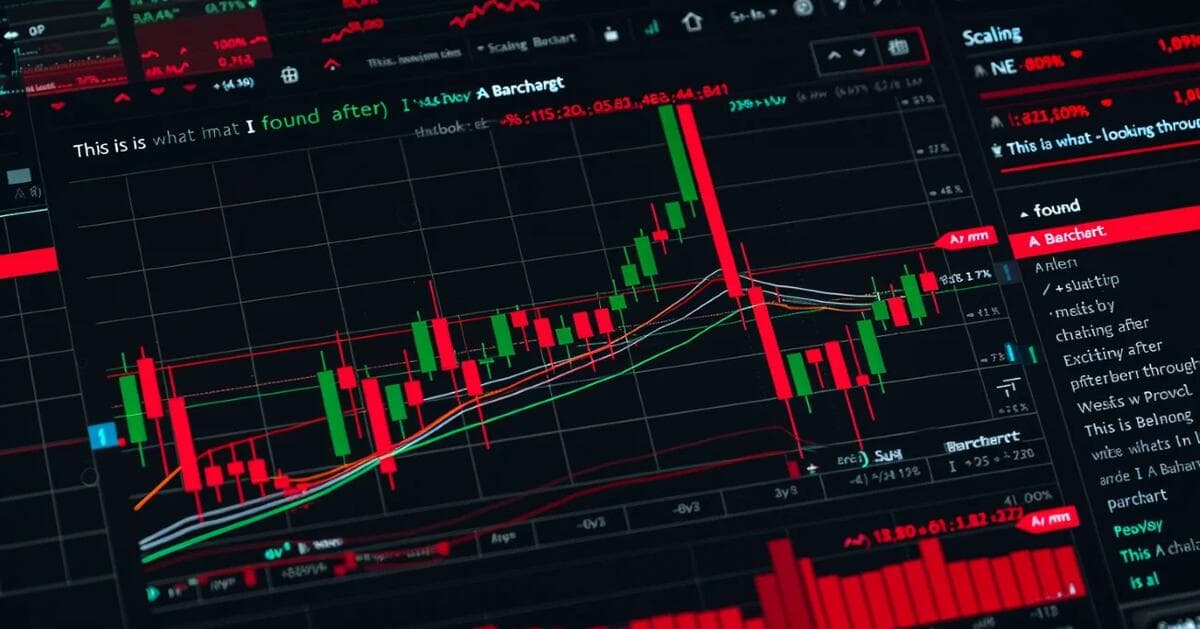
In April 2025, the VIX — the market's best-known gauge of investor fear — surpassed 60 points. To put that in perspective: that level had not been seen since the most intense months of the COVID-19 pandemic. Markets were plunging. Catastrophic headlines dominated the news. Most investors were scrambling to protect whatever they had left.
Twelve months later, the S&P 500 had risen more than 40% from that peak-fear moment. And the VIX? In April 2026, it sits at 19.49 points — less than a third of the peak recorded a year ago.
This is not a coincidence. It is a pattern that repeats in financial markets with surprising regularity: moments of greatest volatility are, frequently, moments of greatest opportunity. The problem is that most investors are so busy managing fear that they cannot see it happening in real time.
What volatility is and why it is so unsettling
Volatility, in technical terms, is the measure of price variation in an asset over time. When prices oscillate widely over short periods, volatility is said to be high. When oscillations are small and gradual, volatility is low.
The VIX, calculated by the CBOE (Chicago Board Options Exchange), measures expectations of S&P 500 volatility over the next 30 days based on options pricing. It is not an indicator of what will happen, but of how uncertain the market expects the future to be. When the VIX rises, the market is literally paying more to protect itself against the unexpected.
The fear of volatility is human and understandable. Watching a portfolio fall 20% in a matter of days triggers emotional responses that directly interfere with decision-making. The problem is not feeling that fear. The problem is letting it dictate actions.
Disciplined traders know something that most people ignore: elevated volatility means, simultaneously, more risk and more opportunity. The key is in separating the two.
The volatility cycle and what the data shows
Recent history offers a perfect case study. In April 2025, with the VIX above 60, the market was in panic mode. But that extreme level carried within it the seed of recovery. When fear reaches its apex, any news that is less bad than expected becomes a catalyst for a rally.
The S&P 500 did exactly that. The 40% rally that followed the volatility peak was no surprise to those who study the historical behavior of the VIX. Levels above 40 rarely sustain for long. Volatility tends to mean-revert, and that reversion process creates strong directional moves in assets.
A year later, the VIX at 19.49 indicates a calmer market, but not a complacent one. The current level is still above the long-term historical average (around 15-16 points), suggesting that investors are still paying for protection. It is a scenario of gradual normalization, not excessive euphoria.
| Reference point | VIX | Context |
|---|---|---|
| Recent peak | 60.13 (April 2025) | Pandemic-level panic |
| Current | 19.49 (April 2026) | Normalization, still elevated |
| One year ago | 33.62 (April 2025) | High-stress period |
| Long-term historical average | ~15-16 | Quiet market |
Concrete strategies for operating in volatile markets
Understanding volatility is the first step. The second is having a clear set of strategies to operate within it. Below are three approaches that make sense at different phases of the volatility cycle.
1. Mean reversion
In conditions of extreme volatility, prices tend to deviate excessively from their historical averages. The mean-reversion strategy rests on a simple premise: what has gone too far in one direction tends to come back.
Practical execution involves identifying assets with significant deviations from short- or medium-term averages, waiting for signs of movement exhaustion (declining volume, divergences in momentum indicators), and entering in the direction opposite to the extreme move with well-defined targets and tight stops.
The VIX peak at 60 in April 2025 was a clear signal of negative sentiment exhaustion. Traders who ran mean-reversion at that moment captured a significant portion of the 40% rally that followed.
2. Breakout from compressed volatility
The reverse also holds. After periods of low volatility, when prices are confined to narrow ranges for days or weeks, the accumulated pressure tends to release in sharp, directional moves. This is what traders call a breakout.
The strategy involves identifying consolidation zones, monitoring Bollinger Bands (when the bands narrow significantly, expansion is approaching), and positioning to capture the first significant directional move.
In the current context, with Brazil in an election year in 2026, this type of setup may arise frequently. Elections create structural uncertainty, which compresses volatility during periods of ambiguity and expands it abruptly at key dates: release of polling data, debates, unpredictable events.
3. Operations based on VIX patterns
More experienced traders monitor the VIX itself as a tradable asset, not just as an indicator. When the VIX is at extremely elevated levels (above 40-50), the historical probability of reversal is high. When it is falling rapidly from peaks, risk assets tend to perform well.
Operationalizing this involves crossing VIX behavior with the movement of underlying assets, seeking to confirm or contradict what the fear index is signaling. A VIX decline accompanied by growing volume in risk assets is a sign that genuine appetite is returning to the market. A VIX decline without meaningful volume can be a trap.
Info
The VIX does not predict the future. It measures current market expectations. Using it as an operational tool requires understanding that distinction and combining it with other indicators before any decision.
Brazil in 2026: a dual layer of volatility
For investors in Brazil, 2026 presents a unique environment of double volatility. On one side, external shocks — the US interest rate cycle, the global trade war, and geopolitical conflicts — continue to pressure emerging markets. On the other, the domestic electoral cycle creates its own source of uncertainty.
Historically, election years in Brazil elevate the risk premium on domestic assets. The exchange rate becomes more sensitive. The yield curve reacts to any looser fiscal signaling. The Ibovespa oscillates with above-average intensity.
For those operating in the short term, this represents more opportunities to capture directional moves. For those investing over a longer horizon, it demands heightened attention to position management and diversification. In both cases, the volatility that appears threatening can be an advantage — provided it is managed with method.
In 2025, global retail trading volume reached $5.4 trillion. A meaningful portion of that volume was generated precisely during the most turbulent moments, when active traders exploited oscillations to build results that calm markets simply do not offer.
Why binary options work well in volatile markets
Binary options have a structural characteristic that makes them particularly suited to high-volatility environments: the result does not depend on the magnitude of the move, but only on its direction.
In a traditional market, a trader who buys an asset and is right about the direction — but misjudges the timing and sees the price pull back before rising — may exit at a loss even though the thesis was correct. In binary options, what matters is whether the asset will rise or fall within a defined period.
In volatile markets, this has concrete implications:
Clarity in oscillations. When volatility is high, moves are more pronounced. A 2% rise on a normal day may become a 5% rise on a high-volatility day. This increases the clarity of the directional signal for those who analyze the market with method.
Built-in risk control. The maximum risk in a binary option trade is known in advance. In turbulent markets, where unexpected moves can amplify losses in conventional positions, this pre-defined risk ceiling is a real operational advantage.
Frequency of opportunities. Volatility generates moves. Moves generate setups. A market in high-volatility mode naturally offers more entry opportunities than a directionless, stagnant market.
Warning
Binary options provide control over maximum risk, but do not eliminate risk. Returns are variable income. Proper position management and operational discipline are irreplaceable, regardless of the instrument used.
Sidnei Oliveira's disciplined methodology
What distinguishes a consistent trader from a speculator is method. Anyone can get lucky on a single trade. What creates sustainable results over time is the ability to repeat a process with discipline, regardless of the market's emotional state.
Over more than 6 years operating in financial markets, Sidnei Oliveira has built a methodology that does not react to the market: it anticipates favorable conditions and acts only when the setup is present.
In practice, this means:
Clear entry criteria. There is no trade "because it feels right." There is a trade because objective, pre-defined criteria have been met. In moments of high volatility, this discipline is what separates those who profit from those who chase the market.
Non-negotiable risk management. With more than 340 monthly operations, the volume demands that each individual trade respect exposure limits. No single trade can compromise the result of the whole. This principle holds in calm markets and, especially, in volatile ones.
Reading the macro context. The events that move the market today — the VIX, Fed decisions, Brazil's electoral cycle, geopolitical tensions — are part of the context of every trade. Ignoring the macro is operating in the dark. Incorporating it into the method transforms noise into information.
Consistency above isolated performance. The goal is not to get one extraordinary trade right. It is to maintain a process that generates positive results over hundreds of operations. In volatile markets, where emotions attempt to hijack the process, this long-term orientation is what sustains results.
Volatility as an entry variable, not a source of fear
The most important shift in perspective a trader can make is to stop seeing volatility as something to be avoided and start seeing it as an operational variable. It is neither good nor bad in itself. It is information.
A VIX at 60 says the market is in extreme fear. A VIX at 19 says the market is moderately concerned. A VIX at 12 says the market is complacent. Each of these scenarios has strategies that work better than others. The trader's job is to recognize which regime they are operating in and adapt the method accordingly.
The 2025-to-2026 cycle offered an almost textbook demonstration of this. From panic at 60 to normalization at 19, with a 40% S&P 500 rally in between. Those with method captured it. Those managing fear missed the move.
2026 still has much to show. Brazilian elections, the global rate cycle, the continuation of the trade war, and the unforeseen events that no analysis can anticipate. Volatility will remain present.
The question is not whether markets will oscillate. It is whether you will be prepared to turn that oscillation into results.
How Royal Binary operates in this environment
At Royal Binary, volatility is not a novelty. It is part of the expected operating environment, and Sidnei's method was built precisely to function within it.
With 340+ operations per month, a track record of more than 6 years, and a 50/50 profit-split model that aligns the interests of managers and investors, Royal Binary offers access to a disciplined management approach that transforms volatility cycles into consistent opportunities.
We operate with full transparency, registered under CNPJ 64.020.950/0001-60, headquartered at Avenida Paulista, 807, São Paulo.
Past results do not guarantee future returns. Returns are variable income.
Tip
Want to understand how Royal Binary operates in volatile markets? Explore our plans and operational history at app.royalbinary.io.